Same Day Mobile Service +1 (213) 788-4018
Home
Services ▼
Service Areas ▼
About Contact

ADAS Calibration By Mobile Auto Glass Genie

Get precise camera, radar, and sensor aiming for driver assistance features with manufacturer-aligned procedures, scan-confirmed verification, and documented completion.
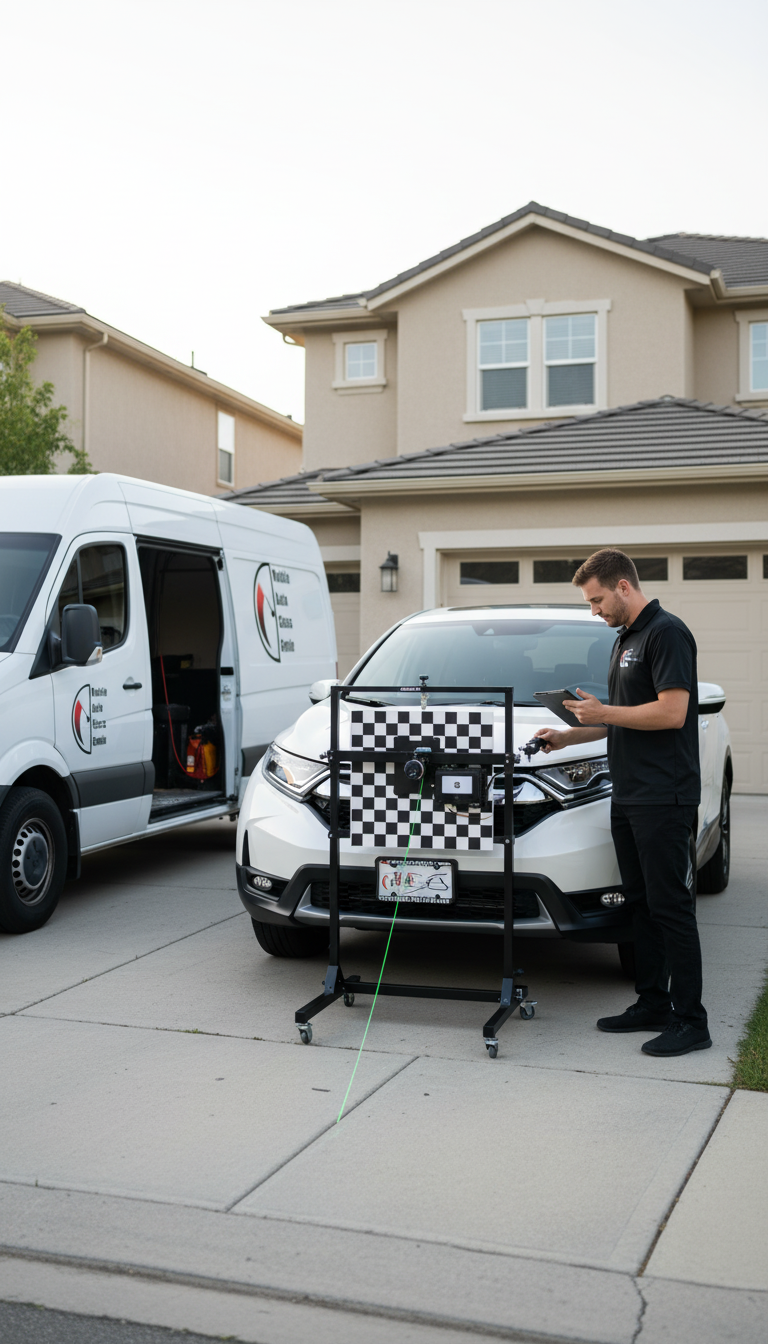
OEM Procedure Aligned Calibration Workflow
Static Calibration and Dynamic Calibration When Required
Pre-Calibration Diagnostic Scan Confirmation
Post Calibration Verification and Confirmation Scan
Calibration Report Provided at Completion
Schedule ADAS Calibration Now
adas-calibration-by-mobile-auto-glass-genie

ADAS Calibration in Los Angeles, CA

ADAS calibration is the process of re-aligning and fine-tuning the cameras, radar, and sensors that drive Advanced Driver Assistance Systems. Because these systems operate with tight tolerances, even a one-degree aiming error can translate into several feet of offset at distance, which can change when alerts and braking actions occur.

Mobile Auto Glass Genie performs ADAS calibration using manufacturer-specified routines and required calibration targets when applicable, then confirms completion with post-calibration verification. Vehicle year, make, model, trim, VIN, and ADAS configuration are used to match the correct calibration pathway and documentation requirements.

Need ADAS Calibration Today? Call Now for Fast Mobile Service +1 (213) 788-4018

Request a Free Quote

Your information will be kept safe and will never be shared.

ADAS Calibration for Accurate Camera and Radar Aiming

ADAS calibration brings sensor aiming back within manufacturer specifications after conditions that can shift alignment. The focus stays on the verified operation of safety-related features tied to camera and radar interpretation.

Advanced Driver Assistance Systems covered

ADAS refers to integrated cameras, radar, and sensor inputs that support automated warnings and interventions during driving.

Why Calibration Matters for Safety Features

Driver assistance features rely on precise aiming to interpret distance, lane position, and relative speed. Even a one-degree misalignment can translate into several feet of offset at a distance, changing when alerts and braking actions occur.

Automatic Emergency Braking AEB

AEB relies on correct distance interpretation to support timely braking intervention when a collision risk is detected.

Lane Keep Assist LKA

LKA relies on camera alignment to recognize lane markings and support steering assistance when lane drift is detected.

Adaptive Cruise Control ACC

ACC relies on radar and camera alignment to maintain a set following distance with stable speed modulation.

Blind Spot Monitoring

Blind spot systems rely on the accuracy of side and rear sensors to reliably detect adjacent vehicles and trigger alerts.

When ADAS Recalibration is Commonly Required

ADAS recalibration is commonly required after changes that can affect sensor angle, mounting position, vehicle geometry, or ride height. The common triggers below help confirm when scheduling is the right next step.

  • Glass related trigger
    Windshield replacement that affects a windshield-mounted camera.
  • Repair related trigger
    Collision repairs or body repairs that may shift sensor angles or mounting alignment.
  • Geometry related trigger
    Wheel alignment or suspension work that changes vehicle geometry and sensor aiming reference.
  • Component related trigger
    Sensor replacement for camera or radar components.
  • Warning indicator trigger
    ADAS warning lights or driver assistance alerts after repairs or adjustments.

Schedule ADAS Calibration Today for Accurate System Performance

Call Now: +1 (213) 788-4018

Static Calibration and Dynamic Calibration

The calibration method depends on the vehicle system design and OEM procedure for the specific configuration. Many vehicles require one method, while some require both.

  • Static Calibration
    Static calibration occurs with the vehicle stationary in a controlled environment. OEM procedures commonly require level surfaces, controlled lighting, and calibration targets placed at specified distances and positions.
  • Dynamic Calibration
    Dynamic calibration occurs during driving when required by the vehicle system. OEM procedures commonly require suitable conditions, such as clear lane markings and monitored verification through an approved diagnostic platform connected to the vehicle.
  • Combined Requirements
    Some systems require static calibration followed by dynamic calibration, based on the manufacturer's procedure and system validation requirements.

Sensors and Systems Calibrated

Sensor location and equipment vary by vehicle trim and ADAS package. Typical sensor groups below define the scope of calibration targets and verification.

Windshield and forward view sensors

  • Windshield mounted camera
  • Forward facing camera

Front detection sensors

  • Front radar sensor

Side and rear detection sensors

  • Side radar sensor
  • Rear radar sensor

Parking and surround view systems

  • Surround view camera systems, when equipped
  • Parking sensors, when equipped

Advanced sensing when equipped

  • LiDAR

What Happens During an ADAS Calibration Appointment

ADAS calibration follows an OEM procedure pathway built around scan confirmation, calibration execution, and verification. Results are tied back to the vehicle configuration and system requirements.

Diagnostic scan and system status

A diagnostic scan checks ADAS related systems for stored faults, calibration status, and readiness indicators tied to manufacturer specifications.

Calibration execution

Calibration is performed using the required targets, measurements, and diagnostic routines specified by the vehicle manufacturer.

Verification and confirmation scan

Post calibration verification confirms completion status and checks for remaining calibration related faults or indicators.

FAQs About ADAS Calibration

01

Does every vehicle require static calibration?

Not every vehicle requires static calibration. Calibration requirements depend on OEM procedures for the specific year, make, model, trim, and ADAS configuration. Some vehicles require static calibration, some require dynamic calibration, and some require both methods.
02

What does the calibration report include?

A calibration report includes documentation of completion and verification for ADAS systems. Reports list the calibration method performed, confirmation status, and scan summary linked to sensors and control modules to verify proper system operation.
03

How long does ADAS calibration take?

ADAS calibration takes 30 to 120 minutes, depending on vehicle system requirements, calibration method, and number of sensors. Static calibration often takes longer than dynamic calibration. Vehicle details and VIN confirm the expected duration.
04

Can calibration resolve ADAS warning lights?

Calibration resolves ADAS warning lights when sensor alignment falls out of specification after events such as windshield replacement or impact. Diagnostic scans confirm the cause. Hardware faults or damaged sensors require additional repair beyond calibration.
05

Which sensors are commonly calibrated?

Calibrate common ADAS sensors, including windshield-mounted cameras, front radar, side sensors, rear sensors, surround view systems, and parking sensors. Sensor coverage varies by vehicle configuration and installed driver assistance features, which determine the number and type of sensors requiring precise alignment and calibration.

Schedule ADAS Calibration with Mobile Auto Glass Genie

Accurate sensor aiming supports reliable driver assistance performance. Book ADAS calibration to align cameras and sensors to manufacturer specifications with scan confirmed verification and documented completion.
Send vehicle details and VIN for confirmation

Our Service Location

Mobile Auto Glass Genie

Serving Los Angeles, CA and nearby areas

Los Angeles Weather

📞 Call Now